Thời trang Nam

[giaban]5,190,000[/giaban]
[giacu][/giacu]
[hot][/hot]
 [hangsx]Samsung[/hangsx]
[tinhtrang]Còn hàng[/tinhtrang]

[mota][/mota]

[chitiet] [/chitiet]

 [gioithieu]

Infestations of Brown Marmorated Stink Bug found on ships en-route to Australia are causing havoc with local supply chains. Bugs are breeding, ships are re-routing, trucks are idling, supply chains are collapsing, costs are escalating... and tempers are fraying.


stink bugs australia maritime
At least three vessels have been ordered by local biosecurity authorities to leave Australian waters and seek insect eradication treatment elsewhere. The latest vessel to be ordered away from Australia was the Thalatta (IMO 9702455), a Wallenius Wilhelmsen car carrier that was ordered away from Fremantle, Western Australia, while carrying a cargo of vehicles and machinery. The other two vessels ordered to leave were also car carrier vessels; one was ordered out in December and the other was asked to leave in November.

It's not just car carrier vessels that are at risk though. So are box ships, break bulk ships and other general cargo ships. It is difficult to overstate the maritime and on-land consequences for a vessel to be ordered away from Australia to seek insect eradication treatment elsewhere.

On the marine-side, FreightWaves understands from local contacts that at least one vessel has incurred over A$250,000 (US$180,000) in direct costs after being ordered to leave Australia. Ports/terminals, marine pilots and other such service providers will charge a "no-show" fee to a vessel that doesn't turn up. Then there's all the wasted expenditure if the vessel actually makes it to Australia only to be turned away – there are expenditures for fuel, provisions, fumigation or heat treatment, crew time, the opportunity costs of not being available for hire and so on. These latter costs are then re-incurred if the ship is sent somewhere else, such as Singapore, for fumigation.

If box ships (as opposed to other types of ships) are ordered away from Australia, there are a variety of other box-specific costs. There are direct costs payable to stevedores in container storage fees, possibly demurrage costs for late discharge of ships (in which a ship has docked but is delayed) and container detention fees payable to the shipping lines for late return of empty boxes.

But that's not all. There are other cost-incurring adverse effects that ripple through the system.

I've got a lovely bunch of… cargo ships

No matter where the insects are detected, they're bad news for pan-Australian logistics. Peter Anderson of the Victorian Transport Association (a trucking company representative body for the state of Victoria) told FreightWaves that infested ships are typically detected in or near either Fremantle or Brisbane. Maritime carriers typically make Singapore their last port of call to pick up trans-shipped cargo of various kinds before heading south to sail the loop around Australia. Ships typically sail in a clockwise direction around Australia from east-to-west on a Singapore-Brisbane-Sydney-Melbourne-Adelaide-Fremantle-Singapore rotation. A smaller number sail in the counter-clockwise direction. These patterns of port calls explain why either Fremantle or Brisbane is often the first port of detection.

"So a ship hits in Fremantle or Brisbane, then it wouldn't have gotten to us [in Melbourne or Sydney] for a week, so it gives us a week to organise ourselves," says Anderson, explaining that ship turn-arounds cause few immediate logistics problems in the two biggest Australian cities.

Those problems arrive shortly after the ship turn-around.

"It throws the schedules out. You have ship bunching – it's not just the cargo that's delayed. You then get something like three ships trying to get into Brisbane at once. Bunching causes problems for transport operators," he said, adding that the turn-back of the Wallenius car-carrier in Western Australia caused bunching in Melbourne a week later.

"We had nine ships bunched in Melbourne because of what happened in Western Australia. Ship bunching causes lots of pressure and activities with no improvement on return," Anderson said.

But the problems, of course, don't end there.

Cascading problems

It's entirely possible that the authorities won't allow the goods or a ship to enter Australia at all. If the ship doesn't turn up when expected, then, on the landside logistics front, there's a cascading effect of disappointments and incurred costs. Importers may miss deadlines on supply contracts. Forwarders and brokers have to tell their customers that their goods are not, or not yet, on the way. There's a loss to trucking businesses for the lost drayage jobs. If the trucks are idled then the drivers are left twiddling their thumbs.

"Drivers still have to be paid. You can't just send them home. It's neither fair to the driver nor the business," comments Simon O'Hara of Road Freight NSW, a local transport body. "Everyone's ready to pick stuff up. They've got their own logistics in place. Systems are in sync with the local port. It's a major pain in the neck," he comments.

Many of these problems can potentially cascade further along in the supply chain in part or full at inland intermodal terminals, distribution centres and customer premises. And then someone has to re-organise, and pay for, the set up of a replacement supply chain ready to move the goods when they actually do land in Australia.

It's a (stink) bug's life

There's a lot of hate for Halyomorpha Halys. And It's not just because the malodorous bug is whiffy (it smells like a particularly rancid version of cilantro/coriander, apparently).

It's fertile.

And, worse, it's hungry.

The stink bug is a mass breeder that feeds on hundreds of different plant species – fruit, trees, vegetables, ornamentals – and it does so by sticking its proboscis inside the plant. That weakens the plant, makes its fruit both visually unappealing and inedible while also making the plant susceptible to infection by pathogens. Crops infested by the stink bug are simply ruined.

And that's a big deal for Australia. The gross value of Australian farm production in 2016-17 was A$60 billion, about three percent of Australia's total gross domestic product (GDP). About 77 percent of that is exported, earning about A$44.8 billion in the 2016-17 financial year, according to the National Farmers' Federation.

Colonial expansion

Unfortunately, the bug is swarming to, and colonising, new areas.

"Forget about high-risk countries being targeted for treatment; the indication from [the Australian] government is that, by next season, we will be talking about treatment of goods from high-risk continents," comments the Freight & Trade Alliance, a locally-based association for the international supply chain sector.

The stink bug is a mobile little hitch-hiker. Originating in northern Asia, the bug is now widely established in Europe and North America. The bug's range is expanding because it's a 2km (1.24 miles) a day flyer that likes to hide en-mass in crevices, cracks and crannies. So it can easily infest cargo-carrying vehicles like trucks, planes and ships. That explains why ro-ro/car-carrying vessels appear to have particularly been affected in the current season: cars, trucks and farm equipment are just full of the little-hidey spaces that the stink bug favours.

Vessels and cargoes from high-risk countries destined for Australia must be fumigated or heat-treated offshore to meet local biosecurity rules. But there there is some concern in the local industry about pre-loading infestation treatments. It appears that Wallenius Wilhelmsen had its vessel and cargo pre-treated, and certified as such, prior to departure. But still the bugs came along anyway. It's not the first time that insects have been found after an eradication treatment has been carried out. It is not known if the presence of insects is due to the pests simply being able to somehow survive, new bugs arriving to make a new home post-treatment, or merely a sloppy job carried out by the exterminators. It may be interesting to note that the local biosecurity authorities stopped accepting certificates for sulfuryl fluoride treatments done in Italy.

"This was in response to [Brown Marmorated Stink Bug] detections and a review of treatment providers and certificates," reads a statement from the Australian Department of Agriculture & Water Resources.

Managing not to manage

There is a lot of local industry criticism levelled at the Australian biosecurity authorities. "We are seeing that the Government's response to [the stink bug] is causing great uncertainty for importers and their customers… we are concerned that greater predictability will not come any time soon," says trade and customs lawyer Russell Wiese of Hunt & Hunt lawyers.

The Freight & Trade Alliance has accumulated a litany of complaints about the bureaucratic response to the stink bug threat. These include allegations of ineffective planning; a lack of trained biosecurity officers; a lack of weekend working and overtime for those officers; information technology failures; too broad profiling in too many areas; delays in processing and inspections; limited treatment options; removal of various insect exterminators from the approved list (including the whole country of Italy); a lack of training for industry; a lack of onshore treatment options; inflexibility in dealing with one-off scenarios; and, finally, a lack of information and quantifiable intelligence.

That's quite a list of criticisms. FreightWaves sought a response from the Australian federal Department of Agriculture and Water Resources. The Department did reply but mostly did not address the charges levelled against it by industry.

A response, edited by FreightWaves for brevity and relevance, reads: "The Department's priority is biosecurity and ensuring we have strict measures in place to safeguard our environment, industries and animal and human health from pests and diseases. We have implemented stronger measures than ever before this season to manage risks associated with this significant pest. The Department is aware of some delays in clearance of imported cargo, and ports in Sydney and Melbourne will be those most affected. These delays have been due to several factors including seasonal trade peaks, system outages and [stink bug] requirements. Importers have been provided with advice by the Department on how they can assist to minimise delays including by having goods treated offshore and early lodgement of required documentation. The Department has deployed all available resources to manage the delays, including engaging additional staff and use of overtime."

Desperate and expensive work-arounds work… for now

Meanwhile, freight forwarders are trying to work around the problems by resorting to "desperate and expensive measures using a combination of sea cargo movements from origin, trans-shipping cargo at intermediary ports [then] using air freight to land goods into Australia," according to the Freight & Trade Alliance.

However, the industry anticipates that this particular loophole will be closed by the authorities and that air cargo shipments will face biosecurity controls before too long. As Wiese comments, "the impact of the stink bug… will motivate our Government to adopt a zero tolerance approach. In the delicate balance between biosecurity and trade facilitation, biosecurity will always win."

Original article from FreightWaves

For more articles on how to manage an efficient supply chain, click here. For more articles like these, subscribe to our blog to get free updates delivered to your inbox.

Whale Logistics are Australia’s Award Winning Freight Forwarder and Logistics company located in Sydney and Melbourne. We deliver digital services such as Australian customs parcel tracking, parcel delivery box, and comprehensive ocean, air and road freight solutions. For cost competitive and innovative ocean freight solutions, please click the link below to contact a Whale Logistics Freight Specialist today for a quote.

[/gioithieu]


[documentimg]


[/documentimg]

Nhận xét

[giaban][/giaban]
[giacu][/giacu]
[hot][/hot]
 [hangsx]Samsung[/hangsx]
[tinhtrang]Còn hàng[/tinhtrang]

[mota][/mota]

[chitiet] [/chitiet]

 [gioithieu]


In this new series, we break down the process of how to import goods into Australia from various countries. The third post in the series focuses on Italy, a major apparel goods exporter.

italy export to australia

Market Background
Below are some interesting background facts about Italy's current economical status:

9th largest economy in the world
4th largest consumer market in Europe
6th largest exporter of goods in the world
Healthcare system ranked 2nd out of 180 economies (WHO)
Over 50 million tourists a year - huge driver of the economy and large contributor to national income
Family-owned SMEs account for 92% of all Italian companies, responsible for 70% of Italian GDP
In 2017-18, goods imports from France were valued at A$6.68 billion, and Australian goods exports to France at A$800 million.

Despite some of the challenges Italy faces, such as high public debt, low growth and regular political change, it also has some contrary elements such as low private debt and a sophisticated manufacturing base. Northern Italy is amongst the wealthiest regions in Europe.

As the third largest economy in the Eurozone, Italy is home to some major multinationals and has a large sophisticated consumer market. The industrial sector is characterised by small and medium enterprises (SMEs) and family businesses, often with a strong regional focus. While subject to EU regulations, there is often local regulations which must adhered to.

Australia and the European Union (EU) launched negotiations for a free trade agreement (FTA) on 18 June 2018. The first Negotiating Round was held in Brussels in July 2018, and the second in Canberra in November 2018.

Source: Austrade

italy suppliers export to australia

How to import goods from France to Australia
1. Product sourcing & validation
Italy has some of the best apparel manufacturers in the world if you’re lucky enough to connect with one of them. Italian artisans have been taught how to make apparel and apparel accessories over decades by their grandparents and parents.

A majority of Italian manufacturers (92%) are SMEs. This makes it easier to negotiate, source, and develop products for startups due to the lower minimum order requirement. Italian goods are highly valued in Australia as being quality-backed by its craftsmen, and are often tagged with a higher price when 'Made in Italy'.

Connecting with a high quality Italian manufacturer can be difficult, especially if you don’t speak Italian and are new to the world of manufacturing.

Australian requirements for importers: Australia has very strict biosecurity laws surrounding certain products. You must keep track of the product safety standards, labelling requirements, and laws surrounding import permits.
Sourcing suppliers: As Italian suppliers are mostly SMEs, and there are no 'directory' like Alibaba for China, it is best to actually visit Italy to source your supplier. Otherwise, beware that there is a language barrier when searching for suppliers online, as most Italian suppliers may not speak English.
Products sourced from Italy are generally higher priced. Use this calculator to see if the manufacturing costs are within your budget.
Product validation is always a necessary step before importing any goods into Australia. If you are a new business, make sure your product or business idea is well and truly marketable and sellable in Australia. Do not over-commit to a big order before doing this step.

2. Discuss terms of trading with your supplier
Your terms of trading could determine how much responsibility you may have with your cargo. Read about our Incoterms and why this is so important to establish from the get-go with your secured supplier. Once your product and contract is signed, it is much harder to renegotiate these terms. On the other hand, if your supplier are unable to extend logistical help, find an exporting agent or freight forwarder that can help you navigate the clearance procedures for each type of incoterm.

customs clearance from france

3. Understand the various regulations, tariffs, and licenses you need to export.
Italy is part of the EU and at this stage Australia and EU does not have a Free Trade Agreement. The process of establishing the FTA is currently in progress (as of Feb 2019) and the successful implementation of one will mean that tariffs will be reduced significantly.

Since July 1, 2009, all companies established outside of the EU are required to have an EORI number if they wish to lodge a customs declaration or an Entry/Exit Summary declaration. An EORI refers to an Economic Operator Registration and Identification, which allows all transit between the EU nations and to/from other nations outside of the EU.

A large majority of Italian imports into Australia are leather goods, as well as other apparel goods. Having a good customs broker that knows the regulations and transporting requirements with leather and other animal-based products will allow you to not only save money by getting it right the first time, but also protect your goods. You may also be required to obtain an import permit with certain categories of imports, such as batteries.

Duty refunds are available also to certain products. To determine whether or not your product is eligible for a duty refund, you will need to know your product's HS Code and do some research on the Department of Foreign Affairs and Trade website. Alternatively, you can also approach a freight forwarder or customs broker and consult with them to see what type of duty refunds and tax exemption programs you are eligible for.

Australia has strict product safety standards. For instance, any products deriving from wood must be fumigated and treated before being released at the border. More often than not this is done at origin as Australian customs will charge you far more. Make sure your product is compliant with Australian safety standards before importing. A list of regulated products is available on Productsafety.gov.au. However, this site does not include electronic product standards and regulations.

If you are importing milk products, animal-derived or food products, you will also require an import permit. This guide from the Department of Agriculture and Water Resources will help you determine whether you need an import permit and how to get one.

importing leather into australia

4. Arranging transport for your cargo ahead of time.
Transporting your goods from France can go much more smoothly if you deal with a courier or freight forwarder. Use the guide below as to who to go to when dealing with France-Australia logistics:

how to import from italy to australia
If you are importing in peak season (October - January), it is important that you arrange for your cargo transport well ahead of time. Read this blog post for more tips to prepare for peak season trading.

Depending on the nature of your goods, many options may be available for transporting your cargo. As a rule of thumb, if you are a beginner importer, it is best to go with a reliable courier such as DHL, TNT, etc. while you build your market volume. If you are a seasoned importer, freight forwarders and 3PL are a great way to improve your profitability and reduce freight costs by pooling the 3PL's resources and leveraging their economies of scale.

To determine what type of transport is best for your cargo, download our Beginners to Freight Forwarding guide.

While speaking to your freight forwarder, it is important to give them the right information so they can arrange the best route and transport options for you. For instance, seafood importers must be able to obtain an import permit and will undergo strict inspection procedures in Australia, therefore this information must be obtained before approaching a freight forwarder.

italy exports in australia

5. Distribute and market your product in Australia
In order to have a success import venture to Australia, your goods must reach the hands of the consumers in the right place, under the right circumstances. Finding retailers and stockists of your products to get your products in the hands of Australians will be crucial to your business plan. Do your research into the target market and where they are hanging out in order to effectively market your product.

Having a 3PL to deal with warehousing and distribution can save huge headaches when it comes to distributing your goods. As seasoned freight forwarders, we also find having the same 3PL as your customs clearance effectively streamlines your entire process and improve your bottom line, and also frees up your time to deal with important business stuff.

Final words for importers from France to Australia
Italians have a formal approach to business interactions and surnames and titles should be used in the early stages, though this may become more informal once stronger ties are established.

Personal relationships are important, face-to-face meetings and visits will generally assist with developing stronger business ties. It is important to make appointments in advance and to be punctual. Conservative attire is recommended for business meetings. Follow up should be undertaken, as responses may not always arrive quickly.

English may not be spoken by all company representatives, so it is advisable to confirm in advance. Local documents and information are generally presented in Italian and translations between languages may be required.

When writing figures, Italians invert commas and decimal points, e.g. 1,5 per cent and € 2.300.000.

As an award-winning freight forwarder and company, we are able to offer our clients a full freight service that includes import/export, customs clearance, 3PL, and warehousing and distribution. We are proud to be Australian-owned, service-focused, translating to highly satisfied clients. We have been named Excellence in Business, Business of the Year, Employer of the Year, to name a few.

Your import journey from France to Australia starts here. Contact one of our friendly Customer Success Managers to see how we can help to transform your business.

[/gioithieu]


[documentimg]


[/documentimg]

Nhận xét

[giaban][/giaban]
[giacu][/giacu]
[hot][/hot]
 [hangsx]Samsung[/hangsx]
[tinhtrang]Còn hàng[/tinhtrang]

[mota][/mota]

[chitiet] [/chitiet]

 [gioithieu]

In this new series, we break down the process of how to import goods into Australia from various countries. The third post in the series focuses on France, a major luxury goods exporter.

france export to australia

Market Background
The Republic of France has a population of almost 65 million people, making it the second most populous nation in the European Union (EU) after Germany. Beyond Western Europe, France has overseas departments and collectivities in the Atlantic, Indian, Pacific and Southern Oceans that account for 20 per cent of its total territory and nearly five per cent of its population.

There are substantial trade and investment links between Australia and France. In 2017-18, Australia’s two-way goods and services trade with France was valued at A$9.9 billion, making France Australia’s 17th largest trading partner, and fourth largest in the EU (behind the UK, Germany, and Italy).

In 2017-18, goods imports from France were valued at A$5.1 billion, and Australian goods exports to France at A$1.6 billion. Australia’s services imports from France were $2.3 billion and Australia’s services exports to France were $931 million.

In 2017, France’s total investment stock in Australia was valued at $24.8 billion. In 2017, the stock of Australian investment in France totalled $51 billion. France is the 9th ranked market for Australian investment abroad.

The top exports of France are Planes, Helicopters, and/or Spacecraft($48.8B), Packaged Medicaments ($24.6B), Cars ($24.1B), Vehicle Parts($18.4B) and Wine ($10.7B), using the 1992 revision of the HS (Harmonized System) classification. Its top imports are Cars ($35.1B), Crude Petroleum($20.6B), Refined Petroleum ($16.7B), Aircraft Parts ($15.9B) and Petroleum Gas ($15.3B).

Australia and the European Union (EU) launched negotiations for a free trade agreement (FTA) on 18 June 2018. The first Negotiating Round was held in Brussels in July 2018, and the second in Canberra in November 2018.

Source: DFAT

france export to australia perfume and cosmetics

How to import goods from France to Australia
1. Product sourcing & validation
Different to China or other South-East Asian manufacturing countries, due to the government’s policy of ‘national champions’, there is a leading French company present in almost all major services and industries. Therefore, your product may be sourced from a large supplier or conglomerate of that industry. It is always important to validate that your product will be well received in the Australian market with proper background market research.

Australian requirements for importers: Australia has very strict biosecurity laws surrounding certain products. You must keep track of the product safety standards, labelling requirements, and laws surrounding import permits.
Minimum order requirements: Major French suppliers require high MOQs in the thousands of units, as any less than this is unprofitable. If you are a small business or start-up, this may not be feasible for you, and you may have to look at a more local or family-business level, where there is higher price per unit but lower minimum quantity requirements.
Sourcing suppliers: There are a few portals where you can browse French suppliers of multiple industries here and here.
Product validation is always a necessary step before importing any goods into Australia. If you are a new business, make sure your product or business idea is well and truly marketable and sellable in Australia. Do not over-commit to a big order before doing this step.

2. Discuss terms of trading with your supplier
Your terms of trading could determine how much responsibility you may have with your cargo. Read about our Incoterms and why this is so important to establish from the get-go with your secured supplier. Once your product and contract is signed, it is much harder to renegotiate these terms. On the other hand, if your supplier are unable to extend logistical help, find an exporting agent or freight forwarder that can help you navigate the clearance procedures for each type of incoterm.


3. Understand the various regulations, tariffs, and licenses you need to export.
France is part of the EU and at this stage Australia and EU does not have a Free Trade Agreement. The process of establishing the FTA is currently in progress (as of Feb 2019) and the successful implementation of one will mean that tariffs will be reduced significantly.

Since July 1, 2009, all companies established outside of the EU are required to have an EORI number if they wish to lodge a customs declaration or an Entry/Exit Summary declaration. An EORI refers to an Economic Operator Registration and Identification, which allows all transit between the EU nations and to/from other nations outside of the EU.

A majority of French imports into Australia are luxury goods, as well as cosmetics and dangerous goods that often consists of alcohol and cannot be transported by air. Having a good customs broker that knows the regulations and transporting requirements with cosmetics, dangerous and high value goods will allow you to not only save money by getting it right the first time, but also protect your goods. You may also be required to obtain an import permit with certain categories of imports, such as batteries.

Duty refunds are available also to certain products. To determine whether or not your product is eligible for a duty refund, you will need to know your product's HS Code and do some research on the Department of Foreign Affairs and Trade website. Alternatively, you can also approach a freight forwarder or customs broker and consult with them to see what type of duty refunds and tax exemption programs you are eligible for.

Australia has strict product safety standards. For instance, any products deriving from wood must be fumigated and treated before being released at the border. More often than not this is done at origin as Australian customs will charge you far more. Make sure your product is compliant with Australian safety standards before importing. A list of regulated products is available on Productsafety.gov.au. However, this site does not include electronic product standards and regulations.

If you are importing milk products, animal-derived or food products, you will also require an import permit. This guide from the Department of Agriculture and Water Resources will help you determine whether you need an import permit and how to get one.

4. Arranging transport for your cargo ahead of time.
Transporting your goods from France can go much more smoothly if you deal with a courier or freight forwarder. Use the guide below as to who to go to when dealing with France-Australia logistics:

how to export france luxury goods to australia
If you are importing in peak season (October - January), it is important that you arrange for your cargo transport well ahead of time. Read this blog post for more tips to prepare for peak season trading.

Depending on the nature of your goods, many options may be available for transporting your cargo. As a rule of thumb, if you are a beginner importer, it is best to go with a reliable courier such as DHL, TNT, etc. while you build your market volume. If you are a seasoned importer, freight forwarders and 3PL are a great way to improve your profitability and reduce freight costs by pooling the 3PL's resources and leveraging their economies of scale.

To determine what type of transport is best for your cargo, download our Beginners to Freight Forwarding guide.

While speaking to your freight forwarder, it is important to give them the right information so they can arrange the best route and transport options for you. For instance, seafood importers must be able to obtain an import permit and will undergo strict inspection procedures in Australia, therefore this information must be obtained before approaching a freight forwarder.

beauty and cosmetics france export to australia

5. Distribute and market your product in Australia
In order to have a success import venture to Australia, your goods must reach the hands of the consumers in the right place, under the right circumstances. Finding retailers and stockists of your products to get your products in the hands of Australians will be crucial to your business plan. Do your research into the target market and where they are hanging out in order to effectively market your product.

Having a 3PL to deal with warehousing and distribution can save huge headaches when it comes to distributing your goods. As seasoned freight forwarders, we also find having the same 3PL as your customs clearance effectively streamlines your entire process and improve your bottom line, and also frees up your time to deal with important business stuff.

Final words for importers from France to Australia
Language is often the main barrier when importing and exporting from France. As so, it is important to do some research into how you will communicate with your preferred suppliers. Although many executives speak English it is courteous to check beforehand.The most important characteristic of French business culture is the emphasis on courtesy and formality.

Titles (Dr, Prof. etc.) should be used both in correspondence and in face-to-face meetings – business contacts are not normally addressed on a first name basis. Style of dress is very important in the business world. For men, office and corporate wear is formal consisting of suit and tie and fashionable semi-conservative wear is considered appropriate for women.

French companies are interested in long-term partnerships and once established they need to be maintained with regular visits to France that will ensure continued collaboration.

Do not schedule business meetings in August (summer vacation) or workdays adjacent to public holidays.

Whale Logistics is the major logistics partner for many France-based companies such as LVMH. We specialize in bringing your cargo safely and efficiently from France to Australia and vice versa. As an award-winning freight forwarder and company, we are able to offer our clients a full freight service that includes import/export, customs clearance, 3PL, and warehousing and distribution. We are proud to be Australian-owned, service-focused, translating to highly satisfied clients. We have been named Excellence in Business, Business of the Year, Employer of the Year, to name a few.

Your import journey from France to Australia starts here. Contact one of our friendly Customer Success Managers to see how we can help to transform your business.

[/gioithieu]


[documentimg]


[/documentimg]

Nhận xét


[chitiet]Giày thể thao nam đẹp da màu nâu cao cấp, thanh lịch từ thương hiệu Converse
Chất liệu giày bằng da bò mềm với chi tiết mũi giày cap-toe
Mắt xỏ dây âm với dây cột nylon
Lót trong bằng da thoáng khí tự nhiên
Đệm lót giày bằng da bọc thoải mái và hỗ trợ chân
Đế ngoài băng cao su hấp thụ sốc tốt và bám tốt trên mọi bề mặt

Được thành lập vào năm 1978, thương hiệu Nine West xuất phát từ địa chỉ ở thành phố New York. Trong 30 năm, Nine West đã phát triển và trở thành người đứng đầu trong lĩnh vực thời trang nổi tiếng thế giới. Ngày nay, giầy - túi xách - trang sức Nine West được yêu mến bởi phụ nữ trên toàn thế giới và được xem như một chuyên gia tư vấn đáng tin cậy trong mọi lĩnh vực thời trang, bao gồm cả thời trang trẻ em. [/chitiet]

 [gioithieu]


Background information

The Incoterms 2010 rules are standard sets of trading terms and conditions designed to assist traders when goods are sold and transported.

The Incoterms rules are created and published by the International Chamber of Commerce (ICC) and are revised from time to time. The most recent revision is Incoterms 2010 which came into force on 1st January 2011.

The definitive publication on the Incoterms 2010 rules is the ICC publication number 715, which is available from various national bookshops.

This is essential reading for those with responsibility for setting a corporate policy or negotiating contracts with trading partners or service providers. Whale Logistics is a freight forwarder and when we work with you to transport your goods, we must agree on common terms in order for your shipment to be handled correctly.

The rules below are extracted from the International Chamber of Commerce. All rights are reserved to the owner of the publication. See here.

Who are the parties involved?

The Incoterms Rules apply to two parties - the supplier and buyer. The supplier is usually the manufacturer, where the goods are sourced. The buyer is the person who is exchanging those goods for money. The rules state which party is involved in what services, such as organizing shipment, transport, and delivery. The buyer/supplier could also outsource these services to a third party, usually a freight forwarder, customs broker or customs agent.

Each Incoterms rule specifies:

the obligations of each party (e.g. who is responsible for services such as transport; import and export clearance etc)

the point in the journey where risk transfers from the seller to the buyer

So by agreeing on an Incoterms rule and incorporating it into the sales contract, the buyer and seller can achieve a precise understanding of what each party is obliged to do, and where responsibility lies in event of loss, damage or other mishap.

Explanation

“Ex Works” means that the seller delivers when it places the goods at the disposal of the buyer at the seller’s premises or at another named place (i.e.,works, factory, warehouse, etc.). The seller does not need to load the goods on any collecting vehicle, nor does it need to clear the goods for export, where such clearance is applicable.

Seller

The only responsibility of the seller is to prepare the merchandise for the buyer, at his own premises, suitably packed for export shipping purposes (in general, the price includes loading the merchandise in the pallet).

Buyer

The buyer is responsible for all the charges and risks involved in the shipment of the merchandise from the moment it leaves the seller’s warehouse until it reaches its destination place. This is the primary Incoterm we use at Whale and thus we handle freight forwarding from the seller direct to the buyer.

The term EXW represents a minimum obligation for the seller. However, if the parties agree that the vendor insures the loading of the merchandise at the point of departure “EXW Loaded”, and make the vendor responsible of these risks and charges, they have to precise this issue very clearly on an explicit clause included in the sales contract (ex: EXW Paris loaded, CCI 2010).

The seller is expected to provide for the buyer, at his request and at his charge and risks, all the assistance required to obtain an export license, insurance and provide the buyer with all the useful information in his possession which will allow the buyer to insure the export of his merchandise in full security.

Illustration


exworks animation whale logistics incoterms

Explanation

“Free Carrier” means that the seller delivers the goods to the carrier or another person nominated by the buyer at the seller’s premises or another named place. The parties are well advised to specify as clearly as possible the point within the named place of delivery, as the risk passes to the buyer at that point.

Seller

If the delivery takes place at the seller’s premises, it is the seller, who handles the loading of the suitably packaged goods into the vehicle provided by the buyer, (specify “FCA seller’s premises”). Export customs clearance is the responsibility of the seller.

Buyer

The buyer has chosen the type of transportation and the carrier with whom he has signed a transportation contract and pays for the main transportation. The transfer of charges and risks takes place at the moment when the carrier picks up the merchandise. The parties must agree upon naming a place where to hand over the merchandise (the carrier’s terminal or the vendor’s premises).

The seller must, should the case arise, provide for the buyer, at the right time, all the assistance needed to obtain all the documents and information regarding the security requirements for the export and/or import of the merchandise and/or for its transportation to its final destination. The cost of the documents furnished and/or the assistance given are costs and risks paid by the buyer.

Geographical precision

More than in any of the other Incoterms, in FCA, the “named place” agreed upon must be precise and indicated with care. FCA (Le Havre) is not enough if the buyer is located in Le Havre. Is it FCA (warehouse Le Havre) or FCA (in-transit bulking warehouse X Le Havre) or even FCA (dock No. X at the port of Le Havre)?

If the delivery is going to be done at a place other than the vendor’s premises, for example: handing it over at a transportation terminal –truck, rail, air, maritime – the vendor will be in charge of transporting the merchandise up to this named terminal but he will not be responsible for unloading the vehicle. The unloading will be handled by the one in charge of receiving the merchandise at the transportation terminal. Prefer FCA instead of FOB if the transportation is done in containers or by roll-on roll-off ship.

Illustration

free carrier animation whale logistics incoterms

Explanation

“Carriage Paid To” means that the seller delivers the goods to the carrier or another person nominated by the seller at an agreed place (if any such place is agreed between parties) and that the seller must contract for and pay the costs of carriage necessary to bring the goods to the named place of destination.

Seller

The seller controls the logistic chain. After having taken care of export customs clearance, he chooses the cargo carrier and pays the charges up to the designated place.

Buyer

The risk of damage or loss is borne by the buyer from the moment that the merchandise is loaded into the first carrier. After that, the buyer takes care of the import customs clearance and the unloading expenses.

Unloading fees

It is important to clarify the concept of who is responsible for the unloading charges into the frame of the transportation contract. Normally, the buyer must be responsible for these charges unless they are included in the transportation fee. In this case, they are charged to the vendor. The vendor must clarify this question with the buyer in order to prevent finding himself in a situation where the receiver refuses to pay and the cargo carrier turns back to the provider (the seller) to demand his part of the payment for the unloading charges as well as the eventual fees for the vehicle’s immobilization while waiting for the problem to be solved.

Geographical precisions

Under the rule CPT, there are transfers of risks and charges in different places. It is recommended that the parties involved specify clearly in their contract the delivery place where the risk is transferred to the buyer and the named destination up to which the seller is required to arrange a transportation contract.

Documents fees

The information and documents related to security, that the buyer needs for the export/import of merchandise and/or for the transportation up to its final destination must be provided by the seller at the request of the buyer and at its own charge and risks.

Illustration


carriage-paid-to animation whale logistics incoterms

Explanation

“Carriage and Insurance Paid to” means that the seller delivers the goods to the carrier or another person nominated by the seller at an agreed place (if any such place is agreed between parties) and that the seller must contract for and pay the costs of carriage necessary to bring the goods to the named place of destination.

‘The seller also contracts for insurance cover against the buyer’s risk of loss of or damage to the goods during the carriage. The buyer should note that under CIP the seller is required to obtain insurance only on minimum cover. Should the buyer wish to have more insurance protection, it will need either to agree as much expressly with the seller or to make its own extra insurance arrangements.”

Seller

CIP is identical to CPT, but the seller must supply, in additional, a transportation insurance. The seller settles the transportation contract, pays the freight and the insurance premium.

Buyer

The risk of damage or loss is borne by the buyer from the moment that the merchandise is loaded into the first carrier. After that, the buyer takes care of the import customs clearance and the unloading expenses.

Insurance Coverage

According to the term CIP, the seller is not obliged to apply for insurance but for a minimum coverage. If the buyer wishes to protect himself by a superior coverage, under these circumstances, he would need to obtain the agreement of the seller or apply on his own for a complementary insurance.

Documents fees

The information and documents related to security, that the buyer needs for the export/import of merchandise and/or for the transportation up to its final destination must be provided by the seller at the request of the buyer and at his own charge and risks. In this case, a third party individual such as a local customs broker may be useful to deploy to minimize problems during documentation preparation, especially if in another country or language.

Illustration


carriage-and-insurance-paid to animation whale logistics incoterms

Explanation

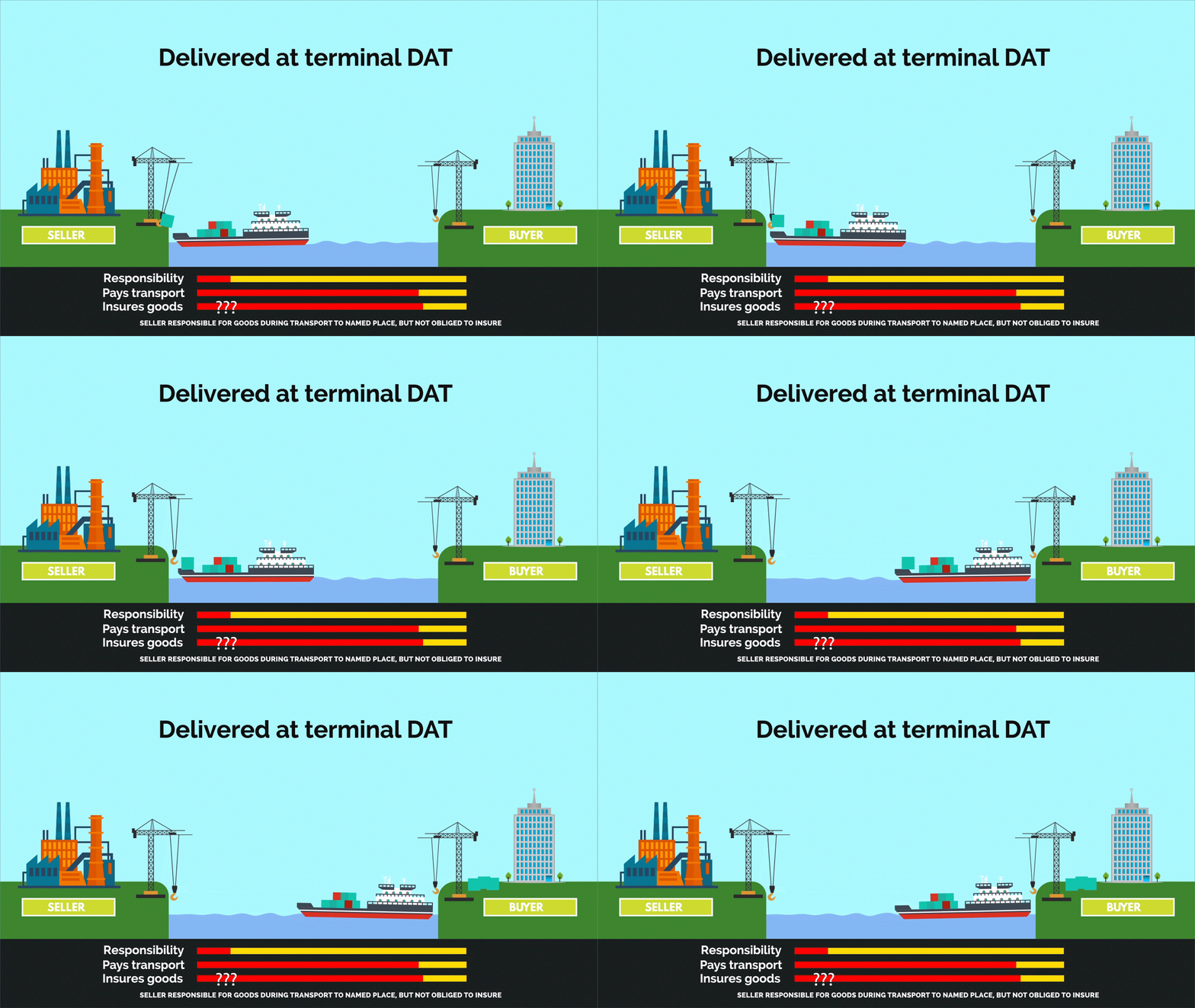
“Delivered at Terminal” means that the seller delivers when the goods, once unloaded from the arriving means of transport, are placed at the disposal of the buyer at a named terminal at the named port or place of destination. “Terminal” includes a place, whether covered or not, such as a quay, warehouse, container yard or road, rail or air cargo terminal. The seller bears all risks involved in bringing the goods to and unloading them at the terminal at the named port or place of destination.

Seller

The seller must deliver the merchandise, placing it at the buyer’s disposal at a designated terminal either at the port or at the place of destination on the date or within the time-limit period established. The seller has to obtain, at his own expense, a contract for the transportation of the merchandise up to the point where it reaches this terminal and unload the merchandise from the transportation carrier at its arrival. The seller has no obligation towards the buyer of obtaining an insurance contract. Nevertheless, he must provide the buyer, at his own expense, the documents that will allow him to pick up the merchandise delivered. The Incoterm DAT obliges the seller to take care of the export customs clearance. However, he is under no obligation of performing the import customs clearance.

Buyer

The buyer (or third party logistics provider) must pick up the merchandise once it is delivered and pay the price agreed on the sales contract. The buyer has to request from the seller all the information related to the security which he will need for the export, import and transportation of the merchandise until its final destination. This Incoterm rule was created specifically for the transportation of containers. It is also adapted to conventional maritime transport when the seller wants to be responsible for the risks involved during the unloading process from the vessel at the port of destination. It is convenient in this case to specify the exact place where the merchandise will be placed at disposal (quay, hoist, etc.).

Illustration


delivered-at-terminal animation whale logistics incoterms

Explanation

“Delivered at Place” means that the seller delivers when the goods are placed at the disposal of the buyer on the arriving means of transport ready for unloading at the named place of destination. The seller bears all risks involved in bringing the goods to the named place.

Seller

The seller has to deliver the merchandise and place it at the buyer’s disposal into the inland freight transportation carrier ready to be unloaded at the designated place of destination. He has to take care of the export customs clearance; however, he is under no obligation of performing the import customs clearance. The seller has to obtain at his own expense, a contract for the transportation of the merchandise up to the named destination and unload it from the transportation carrier at its arrival. The seller has no obligation towards the buyer of obtaining an insurance contract. Nevertheless, he must provide the buyer, at his own expense, the documents that will allow him to pick up the merchandise delivered.

Buyer

The buyer has to pay the price of the merchandise as stipulated in the sales contract and he has to pick up the merchandise once it has been delivered.

Security

The buyer must request from the seller to furnish him with all the information required in relation to the security which he will need for the export, import and transportation of the merchandise until its final destination. This new rule replaces the DDU. It is advised to use it only in the countries where the means of transportation to a destination are under good control.

Illustration

Explanation

“Delivered Duty Paid” means that the seller delivers the goods when the goods are placed at the disposal of the buyer, cleared for import on the arriving means of transport ready for unloading at the named place of destination. The seller bears all the costs and risks involved in bringing the goods to the place of destination and has an obligation to clear the goods not only for export but also for import, to pay any duty for both export and import and to carry out all customs formalities.

Seller

The seller has, in this case, the maximum obligation; he is responsible for all transfer charges and risks until the merchandise is delivered to the buyer. The import customs clearance is also under his charge.

Buyer

The buyer picks up the delivery at the designated destination place and pays the unloading fees. He must request from the seller to furnish him with all the information required in relation to the security which he will need for the export, import and transportation of the merchandise until its final destination.

DDP versus EXW

The term DDP is exactly the opposite of EXW.

Charges relating to the importation of merchandise

If the parties wish to exclude from the seller's obligations the payment of particular fees payable, by reason of imports of the merchandise, it must specify. For example: "Delivered Duty Paid, VAT unpaid (DDP, VAT unpaid)".

Illustration

delivered-duty-paid animation whale logistics incoterms

THIS RULE ONLY APPLIES FOR SEA AND INLAND WATERWAY TRANSPORT

Explanation

“Free Alongside Ship” means that the seller delivers when the goods are placed alongside the vessel (e.g., on a quay or a barge) nominated by the buyer at the named port of shipment. The risk of loss of or damage to the goods passes when the goods are alongside the ship, and the buyer bears all costs from that moment onwards.

Seller

The obligations of the seller are henceforth fulfilled when the merchandise is placed, after customs clearance, alongside the ship at the dock or at the lading of the designated port of shipment.

Buyer

From this moment on, the buyer is responsible for all charges and risks of loss or damages, from the moment that the merchandise is delivered alongside the ship, especially in the case of a ship’s schedule delay or the cancellation of a port of call. The buyer designates the carrier, arranges the transportation contract and pays for the freight.

Obligations of place and moment

The seller does not deliver FAS if the vessel is not at the dock. It is a responsibility of time and moment (From Marseilles to Anvers, where every company offers at least one weekly departure, bringing the delivery eight days before the date of the departure of the ship chosen by the buyer is too premature).

License acquisition

The acquisition of an export license or any other official authorization is at the charge and risk of the seller. In the same way, the buyer is responsible for the import license. The buyer must provide the vendor with all the information regarding the name of the vessel, the loading place and the time chosen to deliver the merchandise within the period accorded.

Documents fees

The seller must, should the case arise, provide for the buyer, at the right time, all the assistance needed to obtain all the documents and information regarding the security requirements for the export and/or import of the merchandise and/or for its transportation to its final destination. The cost of the documents furnished and/or the assistance given are costs and risks paid by the buyer.

Illustration


free-alongside-ship animation whale logistics incoterms

THIS RULE ONLY APPLIES FOR SEA AND INLAND WATERWAY TRANSPORT

Explanation

“Free On Board” means that the seller delivers the goods on board the vessel nominated by the buyer at the named port of shipment or procures the goods already so delivered. The risk of loss of or damage to the goods passes when the goods are on board the vessel, and the buyer bears all costs from that moment onwards.

Seller

He has to deliver the merchandise at the designated loading port, on board of the vessel chosen by the buyer and fulfill all the formalities of export customs clearance, if there are any.

Under a contract type FOB, the seller fulfills his delivery obligation when the merchandise is on board of the vessel at the designated loading port, or in the case of successive sales, the vendor obtains the merchandise and delivers it, as well, in order to have it all transported up to the designated destination place indicated in the sales contract.

Buyer

He selects the vessel, pays the maritime freight, the insurance and he takes care of the formalities at the arrival. He is also responsible for all the charges and risks of loss and damage that could arise to the merchandise from the moment it was delivered.

Variant

For information, the "ARRANGING FOB" is the term used by the freight brokers to indicate that the operations that take place prior to placing the merchandise aboard have been done and accomplished, as well as the export customs clearance operations, if needed. All these operations represent an extra cost, to be paid by the seller, which is sometimes called “fee of placing into FOB”.

The "FOB STOWED" and/or "FOB STOWED and TRIMMED" are variations. The seller is responsible for the total charges incurred by the merchandise at the loading port. However, it has to be stipulated in the contract at which point the transfer of risks takes place.

The seller must, should the case arise, provide for the buyer, at the right time, all the assistance needed to obtain all the documents and information regarding the security requirements for the export and/or import of the merchandise and/or for its transportation to its final destination. The cost of the documents furnished and/or the assistance given are costs and risks paid by the buyer.

The American FOB

The American FOB is different. In the United States, the Incoterm FOB (Free on Board) does not refer to a shipment in a boat or to a port but to an American destination, at the border. In the United States there could be, mainly, four types of FOB:

FOB/Point of departure: The buyer pays for everything;

FOB/Border: The manufacturer pays for the charges up to the border without clearing the merchandise through customs;

FOB/Point of Sale: The merchandise arrives to a designated American city. It is then, the supplier, who pays for customs clearance. The chosen free port must always be marked, in general, the city;

FOB/Destination Customs Clearance: In this case, the manufacturer takes care of everything, without the cooperation of the buyer. It is also called DDP/Delivery duty paid. Most of the sales into the United States are done on this basis.

Illustration


free-on-board animation whale logistics incoterms

THIS RULE ONLY APPLIES FOR SEA AND INLAND WATERWAY TRANSPORT

Explanation

“Cost and Freight” means that the seller delivers the goods on board the vessel or procures the goods already so delivered. The risk of loss of or damage to the goods passes when the goods are on board the vessel. the seller must contract for and pay the costs and freight necessary to bring the goods to the named port of destination.

Seller

He chooses the transportation, contracts and pays for the freight up to the named port of destination; the unloading of the merchandise is not included. The loading of the merchandise after customs clearance into the vessel is his responsibility as well as the shipping formalities. However, the transfer of risk is the same as in FOB.

Buyer

He is responsible for the risk of transportation from the moment that the merchandise is delivered alongside the ship at the loading port; he receives the carrier and picks up the merchandise delivered at the designated destination port.

Documents fees

The seller must, at his own expense, furnish the buyer with a customary transportation document to be used until the merchandise reaches the designated port of destination, covering the contractual merchandise which serves him as a guarantee (ex: claims of merchandise to the carrier, sale of merchandise while in transit, etc.). He also has to provide all the information required in order to take proper measures in receiving the merchandise.

The information and documents related to the security that the buyer needs in order to export and/or import and/or for the transportation of the merchandise until its final destination must be furnished by the seller, following the buyer’s request, and at his own expense and risks.

Illustration


cost-and-freight animation whale logistics incoterms

THIS RULE ONLY APPLIES FOR SEA AND INLAND WATERWAY TRANSPORT

Explanation

“Cost, Insurance and Freight” means that the seller delivers the goods on board the vessel or procures the goods already so delivered. The risk of loss of or damage to the goods passes when the goods are on board the vessel. The seller must contract for and pay the costs and freight necessary to bring the goods to the named port of destination (usually prganized by your freight forwarder on your behalf).

"The seller also contracts for insurance cover against the buyer’s risk of loss of or damage to the goods during the carriage. The buyer should note that under CIF the seller is required to obtain insurance only on minimum cover. Should the buyer wish to have more insurance protection, it will need either to agree as much expressly with the seller or to make its own extra insurance arrangements.”

Seller

It is a term identical to CFR, but with the supplementary obligation for the seller to provide maritime insurance against the risk of loss or damage caused to the merchandise. The vendor pays the insurance premium. The insurance must be done according to the “minimum guarantee” clauses stipulated by the faculties of the Institute of London Underwriters or any other series with similar clauses. It has to cover the minimum anticipated price in the contract plus a surcharge of 10% and it has to be drawn up in the same currency of the contract. It is an insurance FPA (free of particular average) for 110% of its value. It is possible to add a surcharge of 20% without justification. A greater surcharge could be authorized by the insurance company if it is justified. This surcharge over the value serves to cover the expenses that can result from damage (cost of filing and following suit, correspondence, etc.) and the financial loss (interest) between the time of the loss and the indemnification by the insurance company. The seller pays the premium for this insurance.

Buyer

The buyer is responsible for the cost and risk of transportation from the moment that the merchandise is delivered alongside the ship at the loading port. He receives and takes the merchandise from the carrier at the named destination port.

The buyers appreciate this Incoterm because they are released from logistics formalities.

Documents fees

The information and documents related to the security that the buyer needs in order to export and/or import and/or for the transportation of the merchandise up to its final destination must be furnished by the seller following the buyer’s request and at his own expense and risks.

Illustration


cost-insurance-and-freight animation whale logistics incoterms

What are the most commonly used Incoterms?

See below for a table of the most commonly used incoterms, and the duties of each party (seller and buyer).


incoterms-most-common-terms.png


Should I buy CIF or FOB?

CIF (Cost Insurance & Freight) is when the seller must pay the costs and freight includes insurance to bring the goods to the port of destination. However, risk is transferred to the buyer once the goods are loaded on the ship.

FOB (Free On Board) is when the seller must themselves load the goods on board the ship nominated by the buyer, cost and risk being divided at ship’s rail. The seller must clear the goods for export. Maritime transport only but NOT for multimodal sea transport in containers.

The major difference between CIF and FOB is the transportation costs and insurance during it. Therefore, if you are new to international trade, CIF may be more convenient, as it does save you energy and time in dealing with freight and shipping details. However, if you are shipping large amounts of freight, you might consider doing the hard yards yourself as FOB can be cheaper than CIF in most situations.

Who covers the logistics charges?

The below table details who pays for the logistics charges during transportation of goods, such as import customs clearance, main transportation, unloading freight into warehouse, etc. Usually, with a freight forwarder, each stage of your shipment will be handled according to this chart based on responsibility falling on the owner or seller. Your freight forwarder and customs broker should be in contact with you frequently to discuss these charges should they come to you.


incoterms.png

Click to zoom.

DDP - If the seller undervalues goods, can the buyer be liable?

As of May 2016 the Australian Department of Immigration and Border Protection states that under DDP, the buyer may be liable for duty underpayment as a result of seller undervalueing goods.

[/gioithieu]


[documentimg]


[/documentimg]


[giaban]5,190,000[/giaban]
[giacu][/giacu]
[hot][/hot]
 [hangsx]Samsung[/hangsx]
[tinhtrang]Còn hàng[/tinhtrang]

[mota][/mota]

Nhận xét

popup

Số lượng:

Tổng tiền: